


Are you searching for a broker that prioritizes speed and low costs? This deep-dive into IC Markets cuts through the noise to give you a clear analysis of their service, from security and fees to platform performance. Whether you are a high-frequency scalper or a seasoned day trader, this breakdown provides the critical information you need. We deliver a straight-to-the-point review to help you decide if IC Markets is the right partner for your trading journey.
- What Is IC Markets? An Expert Overview
- Is IC Markets Safe? Regulation and Security
- Regulatory Compliance and Licenses
- Client Fund Protection Measures
- IC Markets Pros and Cons
- Trading Platforms: MT4, MT5, and cTrader Explored
- Account Types: Raw Spread vs. Standard
- A Detailed Look at Spreads, Commissions, and Fees
- Analyzing Raw Spread Account Costs
- Understanding Standard Account Pricing
- Non-Trading Fees to Be Aware Of
- Deposits and Withdrawals: Methods and Processing Times
- Tradable Instruments: What Can You Trade?
- Customer Support and Service Quality
- Educational Resources and Trading Tools
- IC Markets Leverage and Margin Requirements
- Order Execution Speed and Performance Analysis
- My Experience with the IC Markets Demo Account
- How Does IC Markets Compare to Other Brokers?
- IC Markets vs. Pepperstone
- IC Markets vs. FP Markets
- Final Verdict: Who Should Trade with IC Markets?
- Frequently Asked Questions
What Is IC Markets? An Expert Overview
IC Markets stands out in a crowded field of online brokers. They operate on a True ECN (Electronic Communication Network) model. What does this mean for you? It means they connect you directly to a deep pool of liquidity providers, including major banks and financial institutions. This structure is built for one purpose: performance. By eliminating the middleman, IC Markets provides raw pricing and lightning-fast execution. This makes them a top choice for traders who rely on precision and speed, such as those using automated trading systems (EAs), scalpers, and active day traders. They focus less on flashy bonuses and more on creating a professional-grade trading environment.
Is IC Markets Safe? Regulation and Security
When you deposit your hard-earned capital, safety is non-negotiable. A core question in any broker review is whether your funds are secure. Concerns like an “ic markets scam” are common when evaluating any financial service, which is why we scrutinize regulation so carefully. IC Markets addresses these concerns head-on with a multi-layered approach to security. They are overseen by some of the world’s most respected financial authorities. This regulatory framework is not just a piece of paper; it imposes strict rules on how they operate and handle your money. Below, we’ll break down the specific licenses and protection measures that form the foundation of their security.
Regulatory Compliance and Licenses
Trust begins with oversight from reputable financial bodies. IC Markets holds licenses from several top-tier regulators across the globe, ensuring they adhere to strict standards of conduct and financial transparency. Depending on your location, you will be covered by one of the following authorities:
- ASIC (Australian Securities and Investments Commission): One of the most stringent and respected regulators in the world.
- CySEC (Cyprus Securities and Exchange Commission): Provides regulatory coverage across the European Union, following MiFID directives.
- FSA (Financial Services Authority of Seychelles): An international authority that allows for more flexible trading conditions.
Operating under these licenses means IC Markets must submit to regular audits, maintain sufficient capital reserves, and provide a fair trading environment. This commitment to regulation is a strong indicator of their legitimacy and reliability.
Client Fund Protection Measures
Beyond licensing, IC Markets implements direct measures to safeguard your money. The most critical of these is the use of segregated client accounts. Your funds are held in trust accounts at top-tier banking institutions, completely separate from the company’s operational funds. This means IC Markets cannot use your money for its own business expenses. This separation is crucial for protecting you in the unlikely event of the company facing financial difficulty. Additionally, they offer Negative Balance Protection for retail clients under certain regulators. This feature ensures you can never lose more than your account balance, protecting you from extreme market volatility.
IC Markets Pros and Cons
No broker is perfect for everyone. A balanced view is essential for a complete IC Markets review. Here’s a straightforward breakdown of their key strengths and weaknesses to help you make an informed decision.
| Pros | Cons |
|---|---|
| Extremely low spreads from 0.0 pips on Raw accounts | Educational materials are limited for absolute beginners |
| Blazing-fast order execution with minimal slippage | The product range is focused on CFDs; no physical assets |
| Choice of powerful trading platforms: MT4, MT5, and cTrader | Customer support is not available 24/7 on weekends |
| Regulated by multiple top-tier financial authorities | High leverage can be risky if not managed properly |
| No fees on deposits or withdrawals | Does not offer proprietary platform for a unique experience |
Trading Platforms: MT4, MT5, and cTrader Explored
IC Markets gives you access to a powerful trio of the industry’s best trading platforms. Instead of pushing a single proprietary platform, they let you choose the one that best fits your trading style. This flexibility is a major advantage.
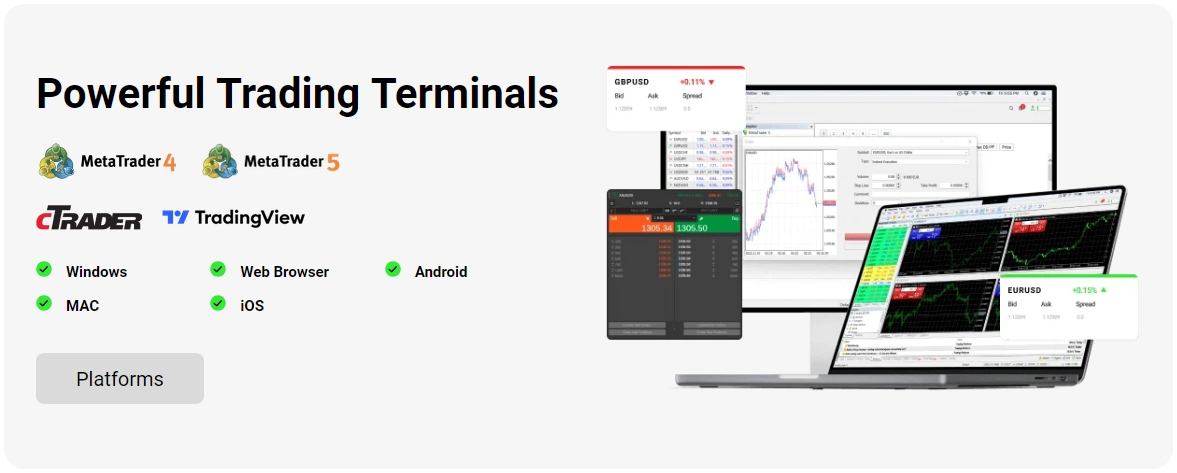
- MetaTrader 4 (MT4): The undisputed king of forex trading platforms. MT4 is famous for its reliability, user-friendly interface, and massive ecosystem of custom indicators and Expert Advisors (EAs). It remains the top choice for many algorithmic traders.
- MetaTrader 5 (MT5): The next-generation platform from the same creators. MT5 offers everything MT4 does but adds more timeframes, more built-in technical indicators, and access to a wider range of markets like stock CFDs. It’s built for multi-asset traders who need more power.
- cTrader: A modern platform designed with a clean interface and advanced order capabilities. cTrader is a favorite among discretionary traders for its Level II pricing (Depth of Market) and intuitive charting tools. It offers a fresh, streamlined trading experience.
Account Types: Raw Spread vs. Standard
Choosing the right account is crucial as it directly impacts your trading costs. IC Markets simplifies this choice by offering two main account types, each with a distinct pricing structure tailored to different traders.
| Feature | Raw Spread Account | Standard Account |
|---|---|---|
| Best For | Scalpers, EAs, and high-volume traders | Discretionary and beginner traders |
| Spreads | From 0.0 pips | From 0.6 pips (wider) |
| Commission | Yes, a small fixed commission per trade | No, commission is built into the spread |
| Pricing Model | Transparent, two-part cost | Simple, all-in-one cost |
The Raw Spread account offers institutional-grade pricing, while the Standard account provides simplicity. Your choice depends on whether you prefer to pay a separate commission for tighter spreads or have all costs bundled into the spread itself.
A Detailed Look at Spreads, Commissions, and Fees
Trading costs can significantly impact your profitability, making this a critical part of our IC Markets review. This broker built its reputation on offering some of the lowest trading costs in the industry. Their True ECN model connects them to a diverse mix of liquidity providers, allowing them to pass on competitive pricing directly to you. In the following sections, we will dissect the cost structure for each account type and also look at any non-trading fees you should know about. Transparency is key, and we will lay out all the details.
Analyzing Raw Spread Account Costs
The Raw Spread account is designed for cost-sensitive traders. Its pricing is broken into two simple parts: the spread and the commission. The spread is the direct price feed from liquidity providers, which can be as low as 0.0 pips on major pairs like EUR/USD during periods of high liquidity. Because the spread is so tight, IC Markets charges a small, fixed commission to execute your trade. This commission is transparent and calculated per lot traded. This two-part structure means you get a clear view of the exact cost of your trade, which is ideal for precise calculation and strategies that rely on minimal entry and exit costs.
Understanding Standard Account Pricing
The Standard account offers a more straightforward pricing model. With this account, there are no separate commissions on your trades. Instead, the broker’s fee is incorporated into the spread. This means the spread you see on your platform is the final cost for opening and closing a position. For example, while the Raw account might show a EUR/USD spread of 0.1 pips plus commission, the Standard account might show a spread of 0.7 pips with no extra charge. This all-in-one approach is perfect for traders who value simplicity and want to see their total cost upfront without needing to calculate commissions separately.
Non-Trading Fees to Be Aware Of
One of the most refreshing aspects of IC Markets is their approach to non-trading fees. They keep these to an absolute minimum, which is a huge plus for traders of all levels. Here’s what you need to know:
- Deposit and Withdrawal Fees: IC Markets charges no internal fees for deposits or withdrawals. While third-party payment providers (like your bank for wire transfers) may impose their own charges, IC Markets does not add any on their end.
- Inactivity Fees: There are no inactivity fees. You can leave your account dormant for any period without worrying about being charged for not trading.
This fee-friendly policy reinforces their trader-centric approach, ensuring more of your money stays in your account for trading.
Deposits and Withdrawals: Methods and Processing Times
Managing your funds should be fast, easy, and secure. IC Markets provides a wide array of payment methods to accommodate traders from around the world. Deposits are typically credited to your account instantly or within the hour, allowing you to capitalize on market opportunities without delay. Withdrawals are processed efficiently, usually within one business day from their end.
| Method | Deposit Time | Withdrawal Time |
|---|---|---|
| Credit/Debit Card (Visa, Mastercard) | Instant | 3-5 Business Days |
| PayPal | Instant | 1-2 Business Days |
| Neteller / Skrill | Instant | 1-2 Business Days |
| Bank Wire Transfer | 2-5 Business Days | 3-5 Business Days |
| Broker to Broker Transfer | 2-5 Business Days | N/A |
Tradable Instruments: What Can You Trade?
A diverse portfolio requires access to a wide range of markets. IC Markets delivers an extensive selection of CFD instruments, enabling you to trade on the price movements of various global assets. This variety allows you to diversify your strategies and react to different economic events. The available asset classes include:
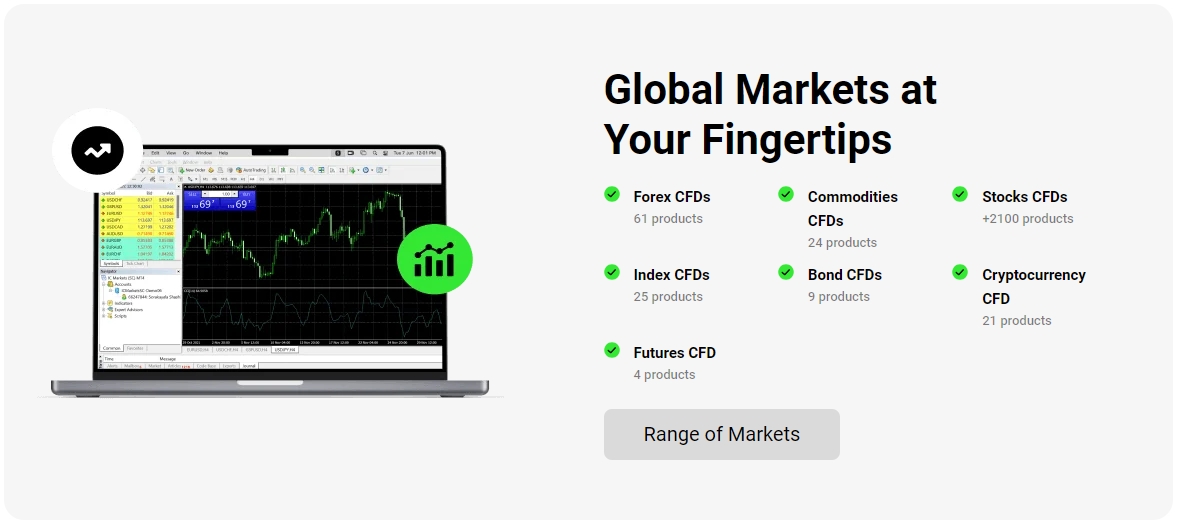
- Forex: Trade over 60 currency pairs, including majors, minors, and exotics, with deep liquidity and tight spreads.
- Indices: Access 25+ of the world’s major stock indices like the S&P 500, NASDAQ 100, FTSE 100, and DAX 40.
- Commodities: Trade on popular energies like Brent and WTI oil, as well as precious metals like gold and silver.
- Stocks: Gain exposure to over 2100 large-cap stock CFDs from the ASX, NASDAQ, and NYSE exchanges.
- Bonds: Diversify with government bonds from around the world.
- Cryptocurrencies: Trade over 20 of the most popular cryptocurrencies against the US dollar, including Bitcoin, Ethereum, and Ripple.
Customer Support and Service Quality
When you need help, responsive and knowledgeable support is essential. IC Markets provides customer service primarily through live chat, email, and a dedicated phone line. Their support team is available 24 hours a day, five days a week, aligning with the major trading sessions. The team is well-trained to handle a range of queries, from technical platform issues to account-specific questions. They are known for their professionalism and quick response times, particularly on live chat.
“My experience with their live chat has been consistently positive. I’ve always connected with a real person in under a minute, and they’ve resolved my issues efficiently without escalating them unnecessarily. This level of support provides real peace of mind.”
This commitment to quality service contributes positively to overall IC Markets ratings and user satisfaction.
Educational Resources and Trading Tools
IC Markets provides a solid set of tools and resources to enhance your trading. While their educational section is not the most comprehensive for absolute beginners, it offers valuable content for those with some foundational knowledge. You will find quality articles, tutorials, and webinars covering market analysis and platform features. Where they truly excel is in providing practical tools that add value:
- Advanced Trading Tools for MetaTrader: A suite of 20 exclusive apps, including a trade terminal, mini terminal, and sentiment mapper, to upgrade your MT4/MT5 experience.
- VPS Hosting: They partner with providers to offer a free Virtual Private Server (VPS) to clients who meet a monthly trading volume requirement. A VPS is crucial for traders running automated strategies 24/7.
- Market Analysis: A regularly updated blog featuring insights and technical analysis from market experts.
- Economic Calendar: An essential tool for tracking important financial events that can impact market volatility.
IC Markets Leverage and Margin Requirements
Leverage is a powerful tool that allows you to control a large position with a small amount of capital. However, it is a double-edged sword that amplifies both profits and losses. The maximum leverage offered by IC Markets depends heavily on the regulatory authority overseeing your account. For example, traders under ASIC or CySEC regulation are subject to stricter limits designed to protect retail clients. In contrast, traders under the FSA in Seychelles may have access to significantly higher leverage. It is vital to understand the leverage available to you and to always use it responsibly. Employing stop-loss orders and trading with a sensible position size are critical risk management practices when using any amount of leverage.
Order Execution Speed and Performance Analysis
This is where IC Markets truly shines and builds its reputation. For active traders, every millisecond counts, and slow execution can lead to slippage and missed opportunities. IC Markets addresses this by investing heavily in a top-tier technology infrastructure. Their trading servers are co-located in the Equinix NY4 and LD5 data centers in New York and London, respectively. These are the same data centers used by major liquidity providers. By placing their servers next to their partners’, they dramatically reduce latency. This results in ultra-fast order execution speeds, helping to ensure that you get the price you click on with minimal slippage, even during fast-moving market conditions. This commitment to speed makes them an ideal choice for scalping and automated trading strategies.
My Experience with the IC Markets Demo Account
Before committing real funds, I always test-drive a broker using their demo account, and my experience with IC Markets was seamless. The sign-up process is incredibly fast—it takes less than a minute to get started. You can open a demo account for any of their platforms (MT4, MT5, or cTrader) and choose your preferred account type (Raw or Standard). The demo environment accurately reflects their live trading conditions, including the raw spreads and commission structures. This provides a risk-free way to test their execution speeds, get comfortable with the platform, and see if their trading environment suits your strategy. I highly recommend anyone considering this broker to spend some time on the demo. It’s the best way to validate the claims made in any IC Markets review.

How Does IC Markets Compare to Other Brokers?
IC Markets is a formidable competitor in the online brokerage space, but it’s important to see how they stack up against other industry leaders. No single broker is the best for every trader, and subtle differences in offerings can be the deciding factor. In the next sections, we will place IC Markets head-to-head with two of its main rivals: Pepperstone and FP Markets. This direct comparison will highlight the specific strengths and weaknesses of each, helping you to pinpoint the broker that aligns perfectly with your trading needs and priorities.
IC Markets vs. Pepperstone
Both IC Markets and Pepperstone are top-tier Australian brokers known for their low-cost ECN-style trading environments. They share many similarities, including strong regulation and a choice of MT4, MT5, and cTrader platforms. However, there are key differences to consider.
- Spreads and Commissions: Both brokers are highly competitive, but IC Markets often has a slight edge with marginally tighter average spreads on major forex pairs in its Raw account.
- Trading Platforms: While both offer the same core platforms, IC Markets has a long-standing reputation for its deep integration with the cTrader platform, making it a favorite for cTrader enthusiasts.
- Educational Resources: Pepperstone generally provides more comprehensive educational content and market analysis tailored for beginner to intermediate traders. IC Markets’ resources are more geared towards experienced traders.
The Verdict: Choose IC Markets for the absolute lowest costs and a cTrader-centric experience. Choose Pepperstone if you value slightly better educational support alongside a very competitive trading environment.
IC Markets vs. FP Markets
FP Markets is another highly-regarded Australian broker that competes directly with IC Markets. Both are known for excellent execution and tight spreads. They both offer MT4 and MT5, but their core differences appeal to different types of traders.
- Core Strength: IC Markets is laser-focused on providing the best possible environment for Forex and CFD traders, especially scalpers and algo traders, through its True ECN model.
- Platform Diversity: FP Markets also offers the Iress platform, which is a powerful tool for traders focused on share CFDs, providing more depth and direct market access for equities.
- Asset Range: Because of the Iress platform, FP Markets offers a significantly larger range of individual stock CFDs, making it a better choice for dedicated equity traders.
The Verdict: If you are a forex or index trader who prioritizes speed and the lowest ECN spreads, IC Markets is the superior choice. If your strategy involves trading a wide variety of individual stock CFDs, FP Markets’ Iress platform gives them a distinct advantage.
Final Verdict: Who Should Trade with IC Markets?
After a thorough analysis in this IC Markets review, the conclusion is clear. IC Markets is an exceptional broker, but it excels for a specific type of trader. Its entire infrastructure is built around providing low latency, fast execution, and some of the tightest spreads in the industry. It forgoes extensive beginner education and promotional offers in favor of perfecting the core trading experience.
IC Markets is the ideal choice for:
- Scalpers and Day Traders: Traders who enter and exit the market frequently will benefit most from the ultra-low costs on the Raw Spread account.
- Algorithmic Traders: The reliable, high-speed server infrastructure and VPS offerings create the perfect environment for running Expert Advisors (EAs).
- Experienced Traders: Seasoned traders who need a no-frills, high-performance platform to execute their strategies will feel right at home.
If you fit this profile and demand institutional-grade trading conditions without the high cost, then IC Markets is not just a good choice—it is one of the best you can make. It delivers on its promise of a professional trading environment, making it a broker we can confidently recommend.
Frequently Asked Questions
Who is IC Markets best suited for?
IC Markets is ideal for scalpers, day traders, and algorithmic traders who require fast execution, low latency, and tight spreads. Its Raw Spread account is specifically designed for high-volume traders who benefit from minimal trading costs.
Is trading with IC Markets safe?
Yes, IC Markets is considered safe as it is regulated by multiple top-tier financial authorities, including ASIC and CySEC. It also protects client funds by holding them in segregated accounts at top-tier banks, separate from the company’s operational funds.
What is the difference between a Raw Spread and a Standard account?
The Raw Spread account offers ultra-low spreads starting from 0.0 pips but charges a small, fixed commission per trade. The Standard account has no separate commission, but the trading cost is built into a slightly wider spread. Raw Spread is for cost-sensitive traders, while Standard is for those who prefer simplicity.
What trading platforms can I use with IC Markets?
IC Markets offers a choice of three powerful and popular trading platforms: MetaTrader 4 (MT4), MetaTrader 5 (MT5), and cTrader. This allows traders to select the platform that best fits their trading style and technical requirements.
Does IC Markets charge any inactivity or withdrawal fees?
No, IC Markets has a trader-friendly fee policy. They do not charge any fees for account inactivity. Furthermore, they do not charge any internal fees for deposits or withdrawals, though third-party payment processors may have their own charges.